



With online ads and social media campaigns playing a huge role in promoting businesses today, it’s natural to question the relevance of print marketing materials and view them as obsolete.
However, research and industry experts suggest otherwise. Print marketing materials continue to hold significant value and offer unique advantages.
In this blog, we will explore the top benefits and challenges of using print marketing materials and how they can play a role in your marketing strategy, even supporting your digital marketing efforts.
Table of Contents
The relevance of print marketing today
Contrary to popular belief, print marketing materials have not become obsolete in the age of digital marketing. In a recent survey of in-house marketing decision-makers in the US, 62% revealed that their marketing department’s use of print materials has either increased or remained constant over the past two years.
While traditional print formats such as newspapers and magazines are still prevalent, recent trends point to the integration of physical and digital marketing. Augmented reality integrations and interactive print campaigns with QR codes and NFC technology are revolutionizing the way print materials engage audiences.
This blending of mediums allows for a more immersive and interactive experience for customers, driving engagement and brand memorability.
5 benefits of print marketing materials
Print marketing materials offer unique benefits that can have a significant impact on your marketing efforts. Let’s explore some of the key benefits associated with using printed materials:
- Building trust in the era of fake news: With fake news and online scams so prevalent, customers often question the credibility of information online. Print marketing materials have inherent credibility as physical objects, making them more trustworthy to skeptical customers. Well-designed and well-written printed materials enable businesses to establish trust and credibility with their target audience.
- Better reach to specific locations and demographics: While digital marketing allows for global reach, it can sometimes lack localized impact. Print marketing materials, on the other hand, enable businesses to target specific locations and demographics more effectively. By strategically placing physical materials in relevant areas, businesses can reach their ideal audience, increasing the chances of conversions and engagement.
- Generating leads through actionable print materials with QR codes: Print materials can go beyond just conveying information. By incorporating elements such as QR codes, businesses can make their print materials actionable, providing a seamless transition from offline to online engagement. For example, a brochure with a QR code can lead customers to a specific landing page or capture valuable data through lead generation forms.
- Effectiveness in attracting new customers: Print advertising has shown to be highly effective at attracting new customers. Recent data suggests campaigns that include print are 67% more effective at delivering new customers. The engaging and effective mix of print advertisements has proven to be powerful in attracting a new client base. Therefore, businesses should not view it as a print vs. digital scenario but rather as an opportunity to leverage the unique strengths of both mediums.
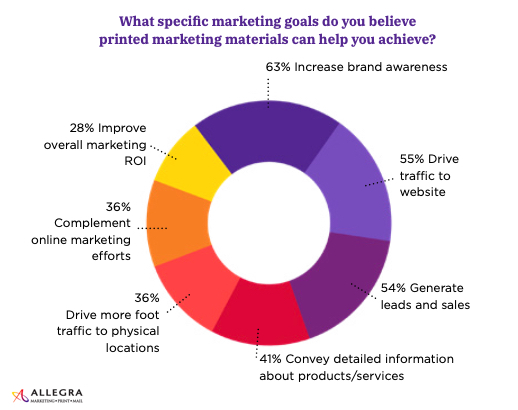
Decision-makers say print marketing materials help them achieve a wide range of goals | Source: MarketingProfs
- Enhanced creativity and memorable experiences: Print marketing materials provide a tangible and tactile experience that digital channels cannot replicate. Whether it’s a beautifully designed business card, a visually striking poster, or a personalized direct mail piece with a compelling narrative, print materials enable businesses to unleash their creativity and leave a lasting impression on their target audience.
A well-executed print piece can engage multiple senses, creating a multisensory experience that enhances brand memorability—something to keep in mind when you’re rebranding, as well.
Learn more: ‘Rebranding strategy implementation: 25 design updates to make before you launch’
5 challenges of using print marketing materials
While print marketing materials offer numerous benefits, they also pose challenges that businesses need to consider. Let’s explore some of the key challenges associated with using print marketing materials:
- Difficulty in measuring effectiveness: Unlike digital marketing, where metrics and analytics provide real-time data on campaign performance, measuring the effectiveness of print marketing materials can be more challenging. It is often difficult to track and attribute conversions directly to printed materials, making it harder to gauge ROI. However, businesses can implement strategies like unique discount codes or custom landing pages to gain insights into the effectiveness of their print campaigns.
- Challenges in optimizing print materials: Optimization and testing are crucial components of any marketing campaign. However, optimizing print materials can be challenging due to limited tracking capabilities. Unlike digital ads, which can be easily updated, print campaigns require production and distribution timelines, making it harder to implement real-time changes based on performance data. Despite this challenge, businesses can incorporate elements like personalized URLs or QR codes to track response rates and make data-driven optimizations.
- Declining circulation of traditional print formats: The rise of digital media has led to a decline in the circulation of traditional print formats such as newspapers and magazines. Businesses relying solely on these formats may face challenges in reaching their target audience effectively. However, the integration of print and digital marketing can help mitigate this challenge by capitalizing on the strengths of both channels to maximize reach and engagement.
- Cost implications and logistics: Print marketing materials involve costs associated with design, printing, distribution, and sometimes postage. Depending on the scale of the campaign, these costs can add up and impact the overall marketing budget. Additionally, logistics such as managing inventory, coordinating with printing vendors, and ensuring timely delivery can be complex. However, businesses can leverage professional graphic design services and explore cost-effective printing options to manage expenses effectively.
- Potential missed opportunities due to production timelines: Unlike digital marketing, which offers real-time flexibility, print marketing requires adherence to production timelines and lead times. This means there is an increased risk of missing time-sensitive opportunities or campaign changes. Businesses need to plan their print campaigns meticulously to ensure they align with the desired timeframes and avoid missing potential opportunities.
How to determine if print marketing is right for you
One way to determine if print marketing can benefit your business is to think about the marketing approach you plan to use, i.e., do you use multichannel, omnichannel, or optichannel marketing? Here’s a quick overview of these types:
- Multichannel marketing: Multichannel marketing refers to using multiple marketing channels simultaneously without integrating them. This approach allows businesses to reach a broader audience but may lack coherence and consistency across different channels.
- Omnichannel marketing: Omnichannel marketing focuses on creating a seamless and consistent customer experience across all marketing channels. It prioritizes integration and synchronization, ensuring that the customer journey is smooth and cohesive regardless of the channel used.
- Optichannel marketing: Optichannel marketing takes a customer-centric approach in which businesses prioritize the channels that deliver the most value and engagement for individual customers. It focuses on understanding customer preferences and tailoring the marketing approach accordingly.
Print marketing can be particularly effective when integrated into an omnichannel or optichannel strategy, as it adds a tangible and memorable element to the overall customer experience.
By evaluating your marketing objectives, target audience, and available resources, you can determine which approach aligns best with your business.
Conclusion
Print marketing materials continue to play a meaningful role in the overall marketing landscape, offering unique benefits and opportunities for businesses.
They possess credibility, enable targeted reach, and create memorable experiences that can enhance brand awareness and engagement. However, businesses need to overcome challenges such as measuring effectiveness, optimizing materials, and managing costs and timelines.
By carefully considering these factors in the context of their specific marketing goals and target audience, businesses can leverage the power of print marketing to complement their overall marketing strategy.
Partnering with professional graphic design services can help ensure that your print materials are visually compelling and effectively convey your brand message. Start here.